There is a way of reading tarot that can make almost any fortune sound impressive.
Turn over a card, list a bunch of keywords. Add a few astrological correspondences. Mention an element. Talk about the card’s “shadow side.” Move to the next card and do it again. By the time you are finished, you have offered the seeker so many ideas that something is almost guaranteed to resonate.
Maybe it does. Resonance, apparently, is just a numbers game.
If I tell you that a card can mean family, inheritance, stability, tradition, wealth, belonging, responsibility, security, legacy and permanence, chances are pretty good that one of those words is going to connect with something happening in your life. That connection may feel meaningful. It may even be useful, but I am not sure it tells us very much about whether the cards themselves actually said anything.
This is one of the reasons I prefer to read tarot more like a rebus.
Make the Cards Commit
A rebus uses pictures to communicate a phrase. An image of an eye might mean “I.” A picture of a bee means “be.” Meaning comes from putting the images together. That is much closer to how I like to approach a tarot reading. Instead of treating every card as its own little encyclopedia, I ask a simpler question:
What is this card contributing to the sentence?
Maybe it gives me a person. Maybe it gives me a place. Maybe it gives me an object, an action or a condition.
Then I look at the next card.
The goal is not to extract every possible meaning from each one. The goal is to see what they say together. In that sense, the cards becomes something like a sentence. One card behaves like a noun. Another might act almost like a verb. Another modifies what came before it.
Call it rebus reading or syntactic tarot. Either way, the important part is that the cards pulled is the unit of meaning.
The individual cards are ingredients. The reading is what happens when you combine them.
Home + Cup + Cup
Take a simple three-card spread:
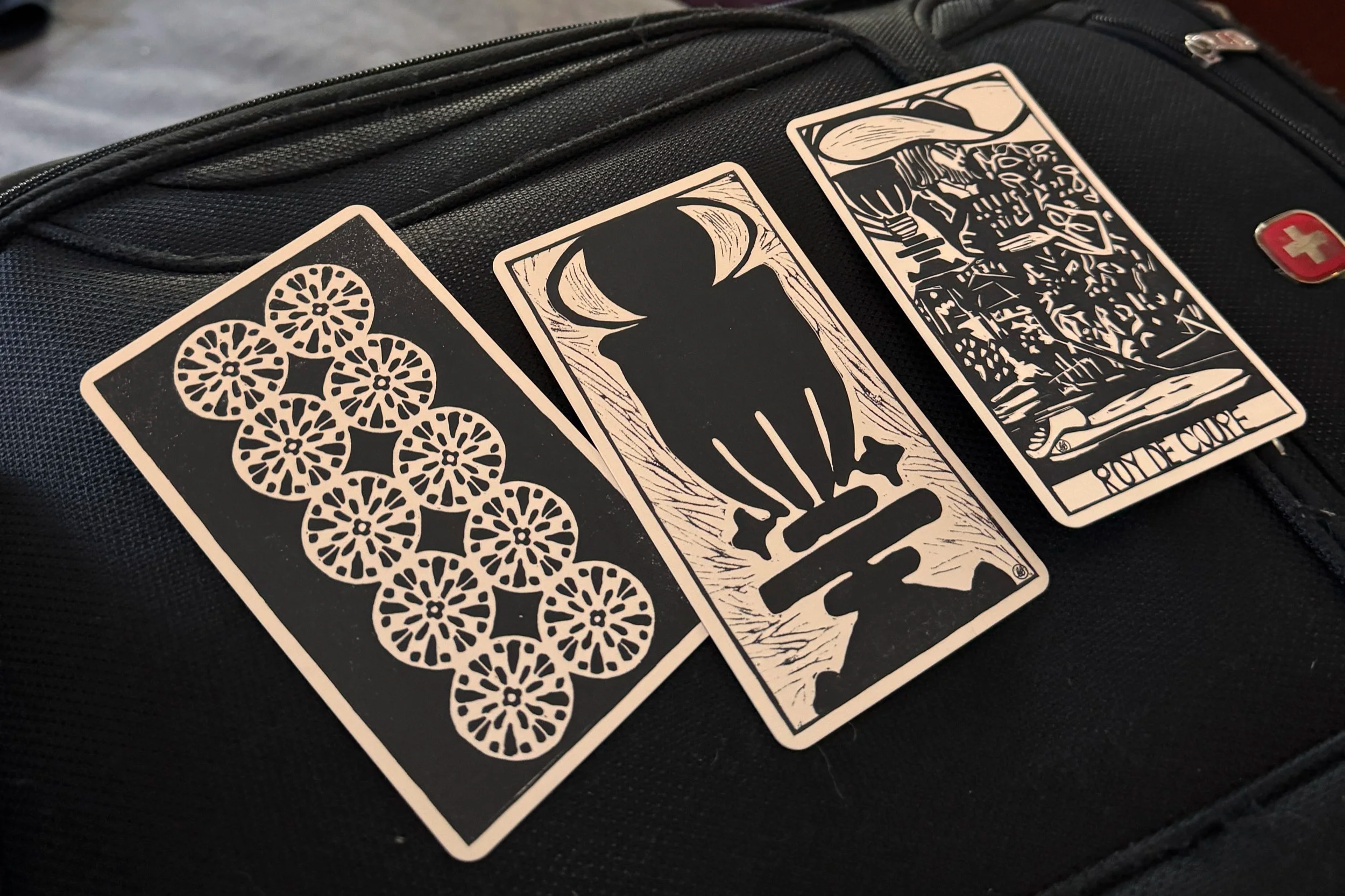
Ten of Coins + Ace of Cups + King of Cups
There are plenty of ways to give a conventional interpretation of those cards.
The Ten of Coins could bring up family, ancestry, inheritance, wealth or long-term security.
The Ace of Cups could mean love, emotional renewal, intuition or a new relationship.
The King of Cups could suggest emotional maturity, compassion, diplomacy or control over one’s feelings.
None of those meanings are necessarily wrong, but now we have three separate bundles of possibilities that the reader has to somehow stitch together. I would rather look at the pictures and ask what very simple ideas they suggest.
The Ten of Coins gives me home.
The Ace of Cups gives me a full cup.
The King of Cups gives me someone who possesses, governs or provides the cup.
Put them together and I get:
Home should be where you never go thirsty.
That is the reading.
I do not need to explain every card afterward. In fact, explaining too much can weaken it. The line contains the fortune.
And “thirsty” can stay slightly ambiguous. It might be literal. It might mean affection, companionship, comfort, hospitality or emotional nourishment. The fortune does not have to pin that down. That ambiguity is different from simply offering a dozen alternatives. The sentence is specific. Its implications are open.
The Problem With Keyword Fishing
This is where I part company with a lot of popular tarot reading. I am suspicious of readings that become enormous clouds of association. Not because symbolism is bad. Tarot obviously depends on symbolism. The problem is that once the interpretive field becomes broad enough, the reading becomes very difficult to falsify.
If every card can mean ten things, three cards can theoretically produce hundreds of combinations. At that point the seeker can do much of the interpretive work themselves. The reader says enough things until the seeker recognizes one.
“Oh, yes. That sounds like my mother.”
Now the reading has a hit.
But did the cards actually point toward the mother? Or did we simply keep throwing darts until one landed?
I would rather accept the risk of being wrong.
That sounds counterintuitive in divination, but I think it matters. A reading should be capable of missing. Otherwise, what exactly does it mean when it hits?
Constraint Is Useful
Reading tarot as a rebus creates constraint. You cannot use every association.
You have to choose.
You have to decide what role each card is playing in this particular spread. And ideally, every card has to earn its place.
If your final interpretation could remain exactly the same after removing one of the cards, that may be a sign that you are not really reading the fortune. You are reading around it. This method asks for economy. Three cards should not necessarily produce three paragraphs. Sometimes three cards should produce seven words.
That can feel uncomfortable at first because tarot culture often rewards elaboration. A long reading looks substantial. Layers of correspondences can make an interpretation sound sophisticated. But complexity and precision are not the same thing.
The more disciplined reading is the shorter one.
Tarot as Syntax
I have started thinking about this approach as tarot as syntax. Syntax is about relationship. A word changes depending on where it appears in a sentence and what surrounds it. Tarot cards can behave similarly.
A Cup beside the Tower does not behave exactly like a Cup beside the Sun. A King at the beginning of a line may establish a subject. A King at the end might resolve an action. A card does not need to carry its entire traditional catalog of meanings every time it appears. It only needs to do its job in the sentence. That also means card order matters.
Change the order and you may change the grammar. The cards are not simply three independent symbols sitting next to one another. They are interacting.
Meaning happens between them.
I Want the Cards to Say Something
Ultimately, this is why I read this way. I want the cards to say something.
Not everything. Something.
I want the fortune to commit to a thought. A warning. An observation. A joke. A little piece of advice. A sentence strange enough that I probably would not have thought of it without the cards, but coherent enough that I can see exactly how the cards produced it.
Sometimes that sentence will be profound. Maybe it will be mundane. Or it will be funny, and sometimes it will simply be wrong. I am fine with that.
I would rather risk being wrong with one specific reading than be right because I gave someone twenty possibilities and let them choose the one that fit. For me, that is where tarot becomes interesting.
Not when every card can mean anything, but when three pictures sitting beside one another suddenly become a divination.
